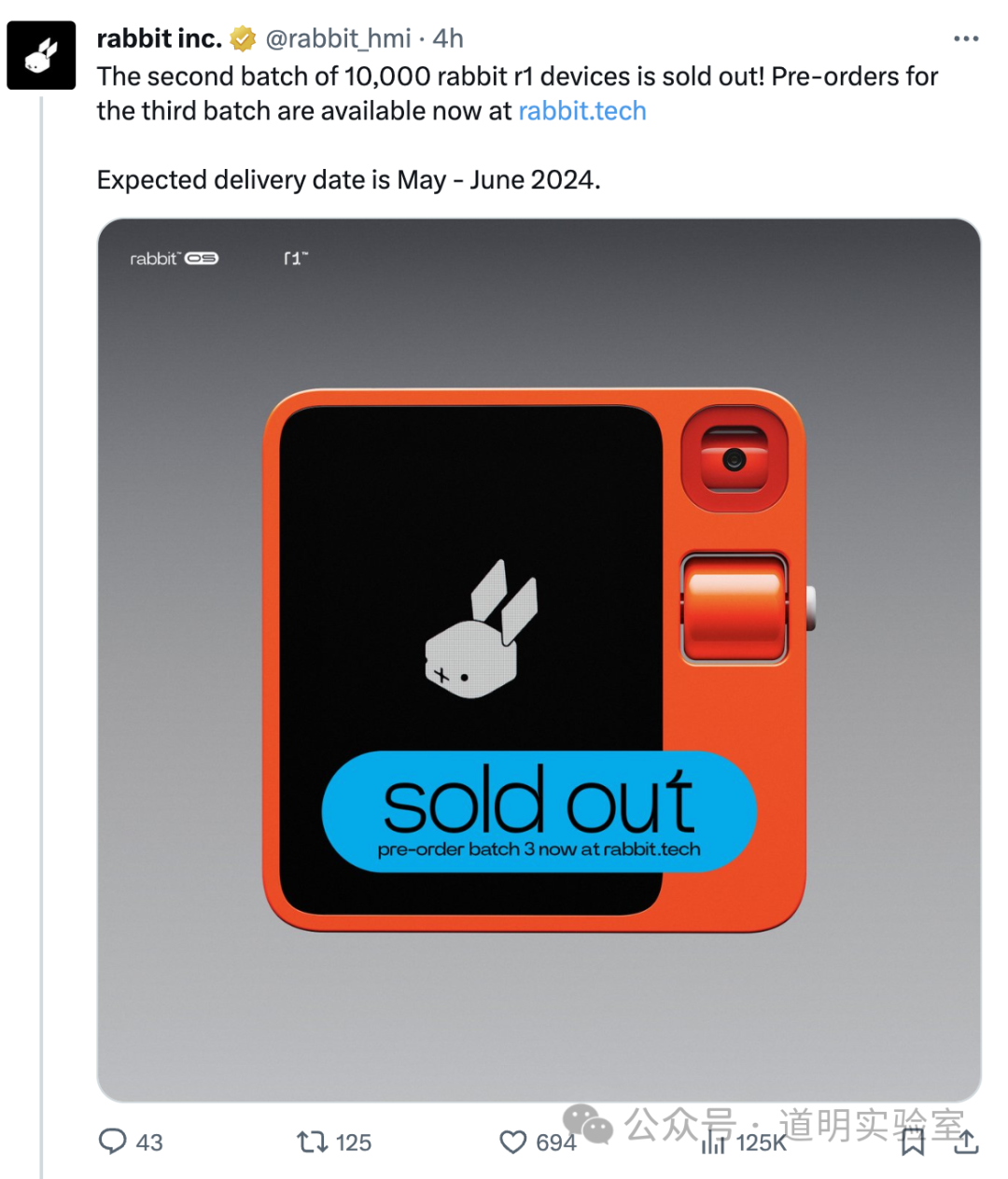
Rabbit announced that it sold 10,000 units of its AI companion R1 within 24 hours of release, and the first batch is completely sold out.
Then, today, they announced that the second batch of 10,000 units has also sold out. Pre-orders for the third batch are now open.
Is selling 20,000 units in two days after release considered a lot? Absolutely! At the same time, it is almost certain to be the most eye-catching product at this year's CES.
For a quick review of this new AI hardware, you can refer to my previous article:
Rabbit R1: This "feel" is right.
Here, I'll briefly summarize why the R1 has become a hit:
Cheap, cheap, and cheap. At $199, many people can afford to try it. I'm starting to worry about the $699 AI PIN. Coincidentally, news of internal restructuring at Humane (the company behind AI PIN) broke today; it doesn't look like a good sign.
Beautiful appearance, perfect size, and a reconstructed interaction model that aligns with the vision of "enthusiast players."
As for the reconstructed operating system + exclusive model + simple operation, these are the product's core competitive advantages. To be fair, quite a few companies could achieve this. However, this is the first one, and it is so remarkably simple that its first-mover advantage is massive. Unless a domestic version comes out for 999 or even 499 RMB.
Anyway, this piece isn't actually about the reasons for its success, but rather relates to some content I've been preparing over the last two days: I originally titled it "Returning to the Pre-Smartphone Era," and I even had GPT-4 generate an image for it.

For over a decade, we've become accustomed to the uniform look of mobile phones: rectangular, a single screen, often without any physical buttons. Younger friends might think phones have always looked this way, unaware that from the "Big Brother" bricks in Blossoms Shanghai until smartphones dominated the world, phone designs were incredibly diverse. Perhaps those twenty years or so were the peak of industrial design. From Motorola, Ericsson, and Nokia to Samsung and even the first-generation smartphone Dopod (HTC), you could recognize the brand and model from a distance.
Nowadays, the only changes are square corners versus rounded corners, whether it has a curved screen, or how the "stovetop" camera array is arranged on the back. Even with the advent of foldable screens, we can skip the parts of product launches where manufacturers drone on about their innovative appearance design. It's not out of disrespect for their efforts, but truly, that self-congratulation often just shows how limited their perspective is.
Actually, you can't blame the manufacturers; it's simply the inevitable result of high industrialization and standardization, and the separation of design from manufacturing. Isn't the modern supply chain designed for rapid iteration at the lowest cost? Naturally, the flip side of efficiency is boredom.
Under the effect of scale, brands and supply chains concentrate at the top. It seems as if a product isn't worth remembering unless it sells hundreds of thousands or millions of units.
By that standard, the R1 is definitely a "nobody." In fact, if we were to look for contract manufacturers, the result would likely be disappointing because it is, in all probability, still a "nobody."
But perhaps this is the beginning of a new normal. We spent over five years transitioning from physical keyboards to pure touchscreens. But now that another decade has passed, do we still need touchscreens? Does the device we need have to be so square and flat? Do we have to obsessively click one icon-represented app after another?
...
AI has turned these previously closed questions into open ones. An era of redefining hardware has begun—or rather, an era of redefining integrated software and hardware devices.
This will be an era of rekindled creativity, much like the pre-smartphone era. We might rarely see a product sell over a million units; even a hundred thousand might be considered a lot. But as the saying goes, "long divided, must unite; long united, must divide." An era where "a hundred schools of thought contend" is always more exciting.
Similarly, we stand at a new juncture—a new juncture for supply chain transformation.