Apple’s pace of releasing one product per day continues; today, it's the MacBook Pro. Actually, what everyone was looking forward to most wasn't the laptop itself, but the specifications of the M4 Max chip. Especially after the previous day's Mac Mini offered generous specs like "64GB unified memory and 273GB/s memory bandwidth," expectations for the M4 Max were high.
However, the results are somewhat disappointing.
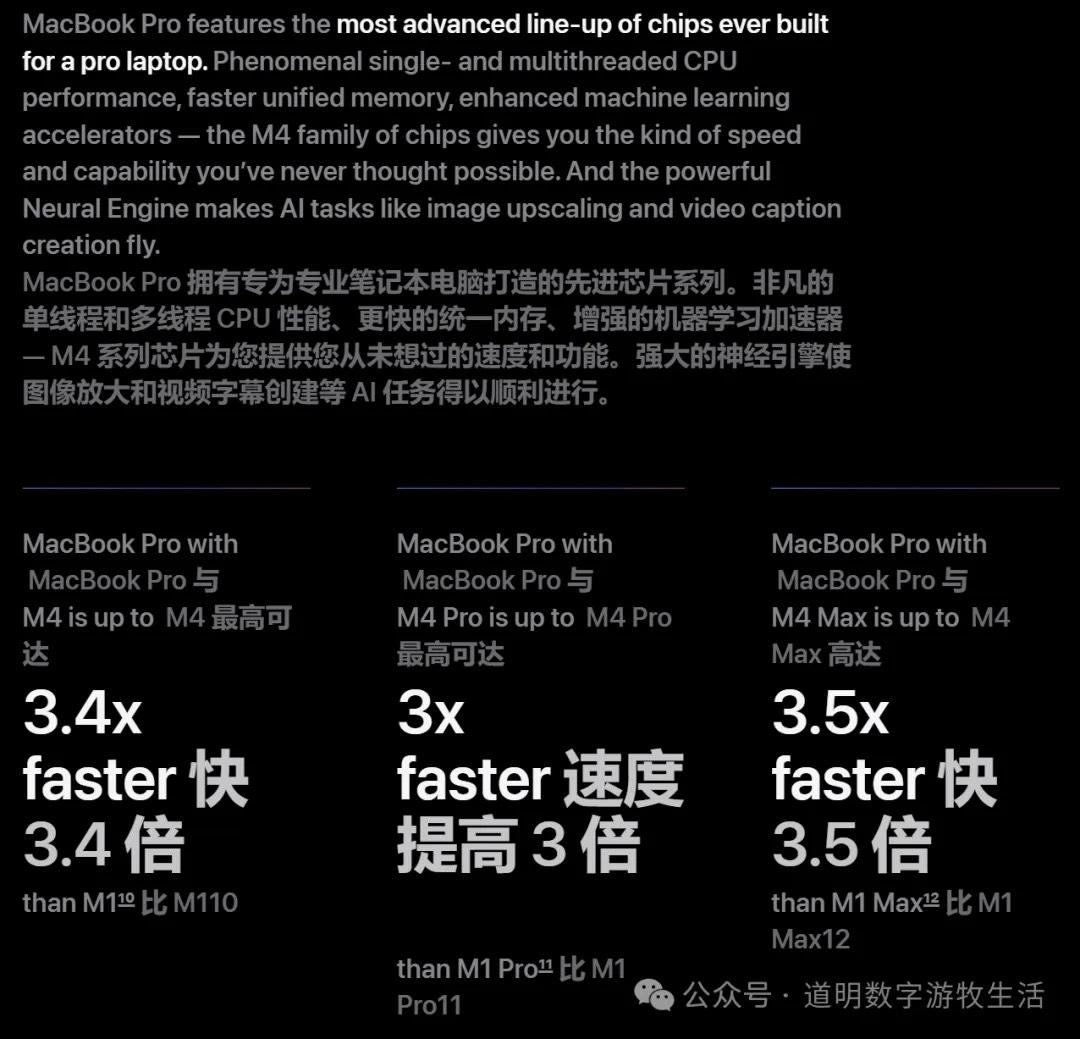
At a glance, although the comparison is against the four-year-old M1 and three-year-old M1 Pro/Max, a three-fold speed increase over three years isn't bad.
The problem lies in the configuration parameters behind the raw performance increase numbers.
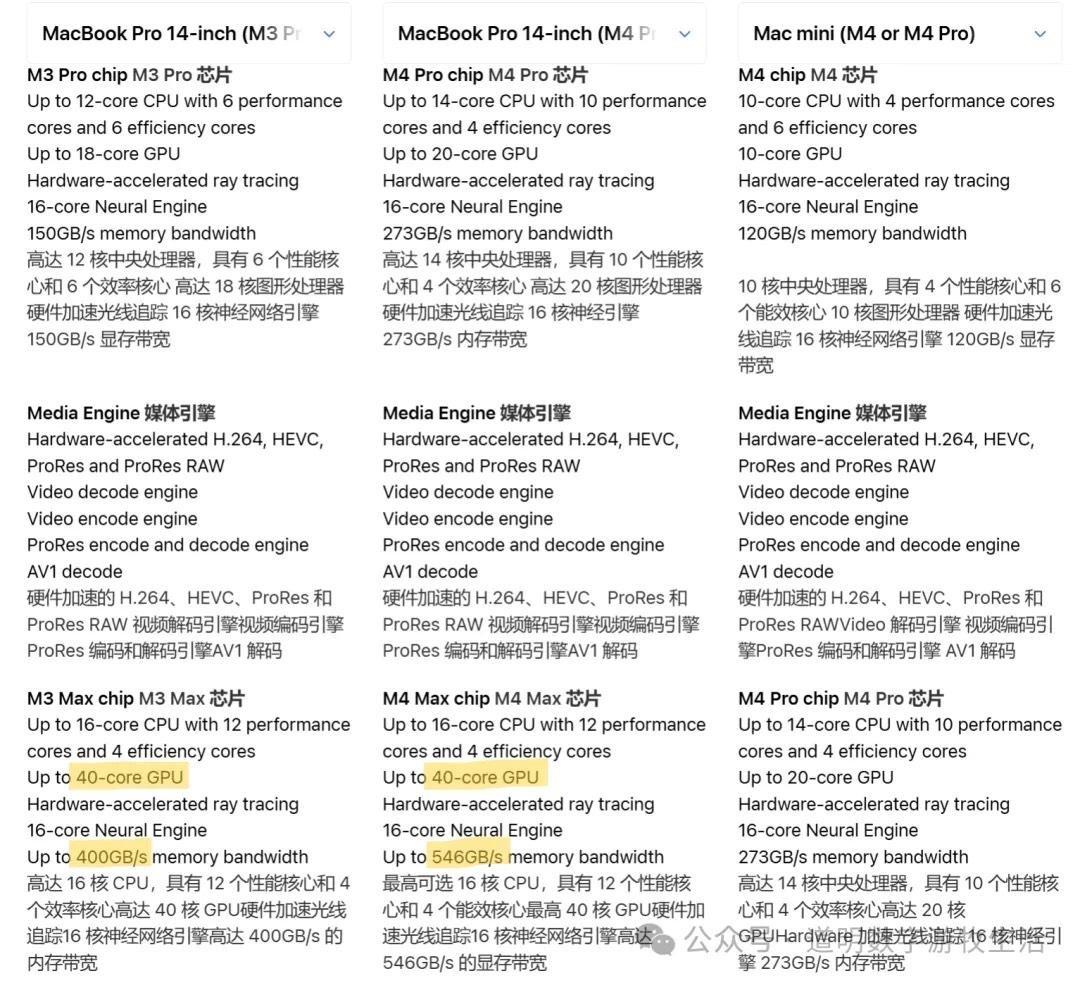
If we compare the most critical parameters of the M4 Max vs. the M3 Max:
- Unified Memory Capacity: 128GB VS 128GB
- Core Count: CPU 16 VS 16; GPU 40 VS 40
- Memory Bandwidth: 546GB/s VS 400GB/s
Aside from the bandwidth increase likely brought by the generational memory upgrade, memory capacity and core counts have not changed.
The upgrades in the high-end Mac Mini configuration gave me hope (historically, the top MacBook unified memory capacity is three to four times that of the Mini, such as M2 being 96GB vs 32GB). Today, that hope was dashed.
Of course, one could argue Apple did this intentionally for market strategy, making us look forward even more to next year's MacBook Air update.
However, there might be deeper reasons behind this:
- Apple's "corporate routine" (precision cutting of specs) is back. This was my biggest fear months ago because, in an era of accelerated AI competition, this is the most harmful approach. I thought this would happen the year after next, but it arrived early.
- Technically speaking, the performance of the M4 today is what the M3 should have achieved last year. This year, despite using the same process node, there should have been higher performance and configurations. Combined with the "stillborn" M2 Extreme (merging two Ultras) and the cancellation of the Ultra version in the M3 series, it seems to indicate significant challenges in manufacturing and packaging.
- Expanding on the point above, my biggest concern regarding AI development this year stems from this: single-chip capability is hitting a technical bottleneck. Evidence is mounting that process improvements (M3 vs. M2) have not significantly increased core counts, and the challenges process improvements pose for Chiplets are far greater than expected (M2 Extreme and M3 Ultra).
As we know, AI can derive computing power from a single chip or increase system power through interconnects. If the difficulty of designing and manufacturing single chips keeps exceeding expectations, what does that mean?
Constant delays.
Apple can use its dominance and the consumer market's relative lack of sensitivity to hardware performance to absorb the impact of delays as much as possible—hence the M3 with only a six-month lifespan.
But what about other companies? This issue has been discussed frequently in offline exchanges recently, but please forgive me as it exceeds the scope of this post.
Finally, back to Apple's new products:
- The M4 Mac Mini is undoubtedly a huge surprise;
- The M4 MacBook Pro is not worth the upgrade at all; the value proposition of the M3 has become immediately apparent (those who just bought an M3 before the M4 launch can feel greatly comforted now);
- We can look forward to the upcoming MacBook Air. Actually, outside of North America, Mac penetration—especially among students—still seems low to me. It's not that kids don't want a Mac; it's that there's always a sense of poor price-to-performance. The Air can provide enough value, a right price, performance and battery life that surpasses Windows, and increasingly better game support.
Perhaps point three is the calculation behind Apple's "corporate vibe." However, no matter how much I favor Apple's prospects in the AI era, you cannot always rely on "market status" to dictate products. That formula for success is a thing of the past.
Look at Sergey Brin returning to the front lines at Google, Mark Zuckerberg getting personally involved, and Elon Musk.
Technological leadership, to some extent, comes from "madmen."