![[Deep Research-5]AIPC,苹果外,我安利华硕双屏](https://payload-backend.dmquant.workers.dev/api/media/file/2025-02-13-deep-research-5aipc苹果外我安利华硕双屏-1u9tef-1771990725458-9655.jpg)
It seems like the peak wave of AI PC upgrades is indeed arriving.
A small side note: at the end of the year before last, in many broad discussions about AI PCs, Apple wasn't even included. It seems that rather than worrying about whether the mass use of AI will lower our IQ, we should reflect on whether we were already "critically ill" due to being overly ambitious but lacking practical skill, even without AI.
To this day, Apple's M-series chips remain the best chips for desktop and laptop AI applications, bar none. This is even before discussing the fact that, besides providing the best user experience, macOS offers far better system compatibility in the AI era than Windows due to its Unix-like foundation.
Don't bring up discrete graphics cards from NVIDIA, AMD, or even Intel. Can a discrete graphics card be "independent" without the CPU?
Apple has no drawbacks except for being expensive.
Therefore, if budget is not an issue, and you aren't in a specific profession with high requirements for document formatting (where macOS compatibility with Office is imperfect), there is no other option but Apple.
However, there is still a larger demand for non-Apple products, whether due to budget, corporate procurement policies, or a preference for Windows. But in the Windows domain, the choice of chips, brands, and models is dizzying. With Deep Research, which is perfect for screening such vast amounts of information, I had Gemini perform a Deep Research session. The results were quite good, especially for users whose needs aren't very clear and who don't know much about hardware.
Of course, this is the result of AI focus, with prices mostly kept within $1,500.
If I were to make a recommendation, I would unhesitatingly choose the 2024 version of the Asus Zenbook Duo. The Amazon price is $1,700, which is slightly high, but the advantages are clear.
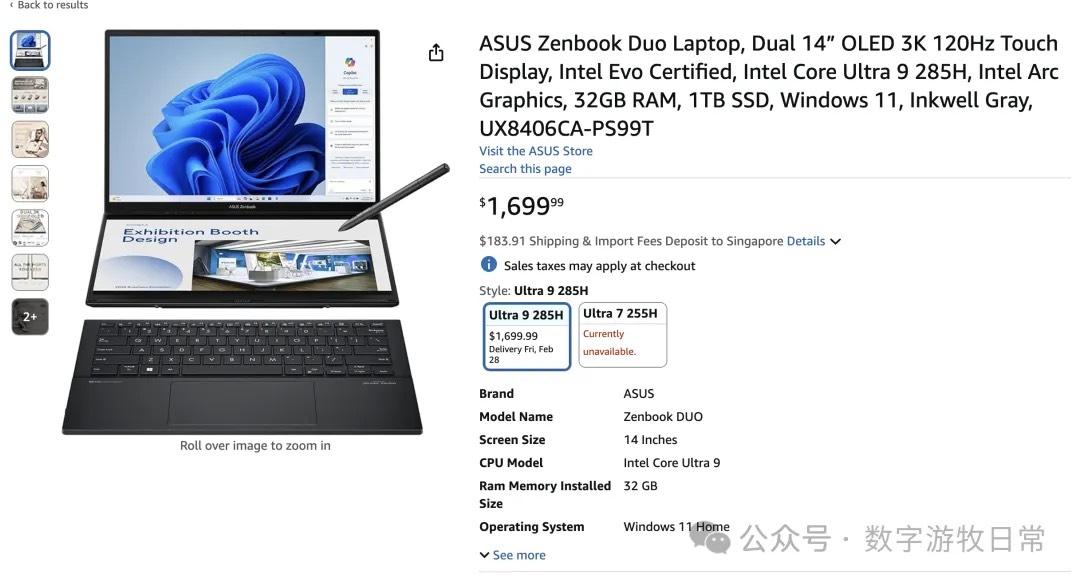
This is the 2024 version, the second in this series. When the first version came out last year, I bought it immediately. My reasoning was simple: dual screens, and the Intel Core Ultra chip could balance portability and AI applications.
I wrote a brief review about a year ago. Those shortcomings I mentioned then are still there, but the "blame" lies mainly with Microsoft. As long as you accept the "weakness" of Windows, everything else is an advantage.
Wintel Fails at AI PCs
- The dual screens are fantastic;
- It's light enough;
- 14 inches is the optimal size for a laptop;
- Battery life is far behind Mac, but much better than previous laptops;
- Two Thunderbolt 4 ports surpass many laptops and are very useful, for example, for connecting a high-end NVIDIA GPU;
In the new 2024 version, the biggest change is in the Intel chip, upgrading from the "Core Ultra 9 185H" to the "Core Ultra 9 285H," with the architecture moving from Meteor Lake to Arrow Lake.
Not only has performance improved, but power efficiency has also progressed.
Regarding AI capabilities, some reviews might say this chip's NPU computing power is a drawback. On the contrary, I believe that on a laptop, "good enough" is fine. What's important are heat dissipation (hot air and noise) and battery life. Naturally, dual screens will have lower battery life than a single screen, but if you often need to work in places like Starbucks, the experience of dual screens boosting productivity is something you "can't go back from."
Conclusion: Outside of Apple, if you have the budget, choose the Asus dual-screen. Aside from the Windows bottleneck, everything else is a strength.
Gemini's Deep Research output a report on choosing AI PCs that was over ten thousand words long; I won't post the full text. When I used NotebookLM to generate an "Audio Overview," the 25-minute conversational podcast effect gave me a much better experience than watching the "awkward chatter" in those influencer hardware review videos.
The great era has truly begun.