This piece will likely be very short and abstract. I was originally going to write about content site deployment today, but Claude Code caused some "minor disasters" during "work." In the process of fixing them, I was "carried away" by some new thoughts, so, in my usual style, the plan has been temporarily modified.
Actually, the concept of a "one-person company" has existed for nearly ten years. Of course, it's not literally one person, but a very limited number of people—maybe five or six? At most ten? In terms of roles, there is no distinction between front, middle, and back offices: because if you don't understand the back end, you can't do the front end well; if you don't understand the front end, you can't become a reliable back end.
Of course, the primary foundation for a "one-person company" (or small team) is today's "platformization"—not just digital infrastructure, cloud services, and internet platforms, but also manufacturing and logistics. Naturally, this concept has been repeatedly mentioned after the current AI explosion because the visibility of results for a "one-person company" is now much stronger.
Furthermore, under the torrent of the times, if we accept the logic behind "tissues largely replacing handkerchiefs" and "the prevalence of disposable tableware" (not the results or the moral judgments behind them), then we should accept similar logic behind "AI-generated disposable code disrupting software engineering" and "AI search disrupting knowledge production." Again, it's about the logic, not the results or moral judgments.
Programs are ultimately born to achieve a certain function. As long as they are generated fast enough to handle the task at hand, most people will no longer need complex software systems. Moreover, disposable programs may better align with natural human habits and creative advantages.
If the ocean (the platform) is wide and deep enough, we can just dig a well and "circulate" with it directly. Why bother connecting with other vertical silos? Mistrust and defensiveness are natural human traits; what can be connected are similar ideas, values, and interests—not boring "alignment of granularity."
As I find it increasingly difficult to convince my daughter of the importance of "teamwork," I have gradually chosen to wait and see, leading to the thoughts above. Simultaneously, I've turned to discuss other issues, like why "Italian Brainrot" went viral, and questions regarding Gen-Z.
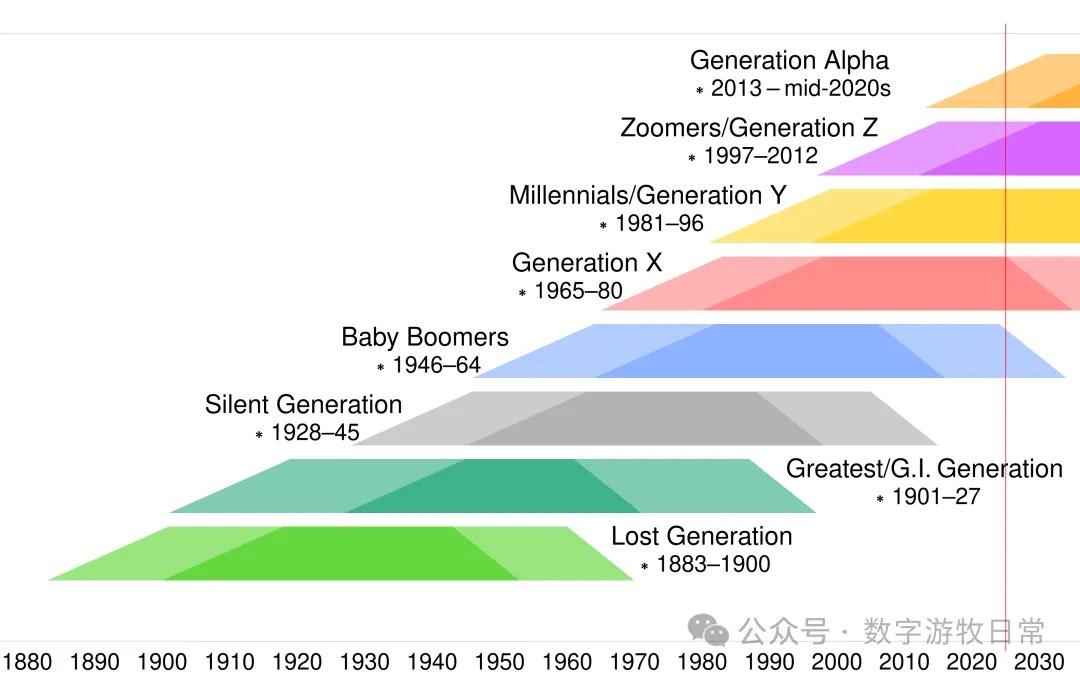
Another discussion point was why Gen-Z is called "Zoomer." My daughter answered that it's because they used "Zoom" for classes. I speculated whether it's because they've been in contact with electronic devices since birth, and their habitual operations are "Zoom in" and "Zoom out." Of course, a more logical explanation is a play on words corresponding to the post-WWII Baby Boomers ("Boomer"), replacing "B" with "Z." As a historical background, they were indeed born after the massive development of information technology.
I've habitually let my thoughts wander again.
Of course, this is not entirely unrelated to the next topic. If the times are as they are, debating "right or wrong" on some moral scale regarding the results is meaningless.
So, regarding the second topic, there's really only one sentence:
Since it has become so easy for one person to dig a well in the ocean, one should seize every opportunity to extract fresh water and minerals from the sea, filling one's "one-person pool" until it becomes a pond, a lake, or even a sea. (Accumulate relentlessly.)
If the result of "cooperation" and "granularity alignment" is to make it easier for others to dig wells on your own lake, then don't cooperate and don't align.
Only walk with those who are digging their own wells in the ocean.