This article is not exclusively focused on AI, so I did not use the title "AI Infrastructure."
Nor will this piece contain much rationality or data analysis. Such "boring" work is already handled well enough by current AI; let’s not "steal its job."
Therefore, this article is simply a collection of reflections following recent observations and sudden events. Although AI and rational analysis will still occupy a significant portion, the "inspiration points" and the rational analysis are two quite distinct parts.
Recently, an interview video on TikTok about Singapore being "boring" caused a lot of debate. I absolutely agree with this evaluation. As a highly modernized city (and nation) with six million people and a very small land area, efficiency and clear boundaries result in being "boring." Almost everything brought about by rationality and clear goal orientation might be boring—like the neural networks that form the basis of AI, day-to-day work tasks, and so on.
Another controversial and perhaps most tragic recent event is the Texas floods, where the death toll has now exceeded 100. Cultures and beliefs may differ, but whether it is a natural disaster or a man-made one, hearing an "official" response like "an act of God" always leaves a bitter taste. Of course, we can at least draw a preliminary conclusion: due to cost and other issues, warning facilities in the hardest-hit counties are outdated.
I link these two events because they remind me of a book I read years ago called Scale. The author spent a lot of time discussing research on the scaling effects of large cities. The "1/4 power-law" relationship also left a deep impression on me (to be precise, I checked the book again: in biology, it is a 1/4 relationship, meaning as an organism's weight grows, energy savings are about 25%; for a city or a company, this figure is about 15%).
Returning rationally to the relationship between the two events: big cities can have higher efficiency and lower costs, but they also bring more pressure and a greater sense of boredom. Small towns (I know many readers have US IPs and I know the concept of a "county" isn't directly related to size, so calling them "towns" might be more appropriate) face higher costs and lower efficiency. Of course, if we focus on natural disasters, we can analyze it this way: because the risk of loss in a large city far exceeds that of a "town" once a disaster occurs, there is more motivation to improve warning systems, emergency response mechanisms, and a whole series of "infrastructure."
To some extent, the larger the city, the higher the management level required, and the more rules and dogmatic settings there are. Higher efficiency is, in a way, positively correlated with the subjective feeling of "boredom."
Humans generally cannot escape the balance between efficiency (returns), cost, and "boredom." From my own subjective perspective, I have another dimension of consideration: due to my personality and age, I am willing to accept an increasing "proportion of boredom." This allows me to exist with lower costs and less mental exhaustion, and makes me cherish the small percentage of "interesting" things even more.
Perhaps modern people simply need more and richer "infrastructure" to support themselves.
Yesterday, I also had Gemini conduct research on the current heatwave and power grid stress (in Europe and the US). A graph it returned and the mention of the "solar cliff" aren't exactly new, but they might be interesting to many people.
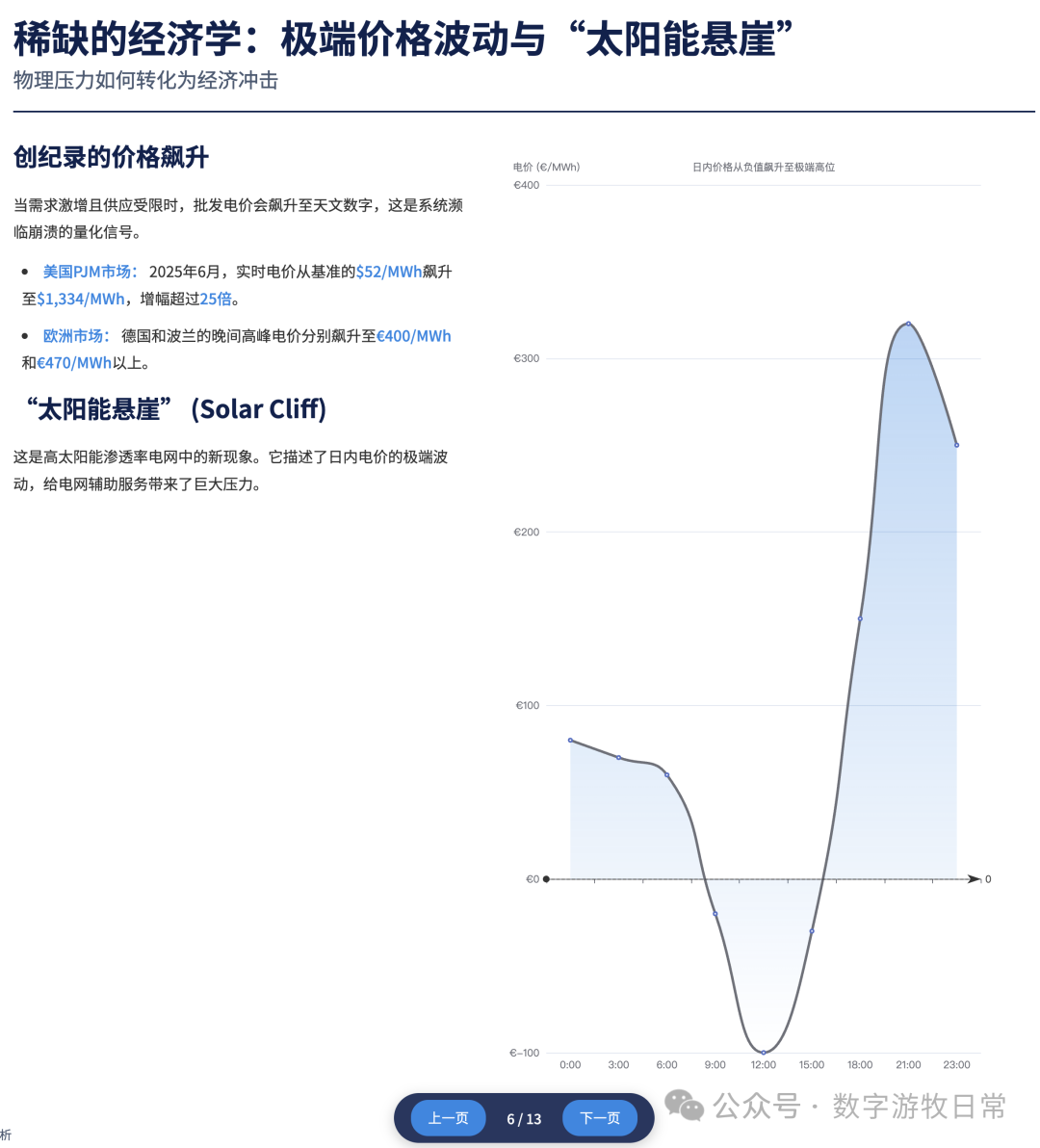
This coincides with an in-depth report from The New York Times (yes, it is still an important source of serious information for me, although I admit its reporting bias is becoming more severe) about the different paths China and the US are taking in energy infrastructure construction (especially the "New Energy vs. Traditional Energy" debate following the passage of major bills).
Reviewing the book Scale just now provided an extra benefit: it reinforced my view that "no matter how technology advances, energy demand will only rise as human society develops, rather than fall."
I have no preference for green energy over fossil fuels, nor do I have an "obsession" with the relationship between "global warming" and "carbon emissions." But I do have an "obsession" with technological progress. Although the direction of technological progress is often quite "boring," "green electricity" incorporates a large number of new technologies and is constantly iterating. What about traditional energy? I know very little, but the progress of such long-matured technology must at least be very slow.
I am still an "old-school" person who prefers internal combustion engine cars far more than "electric vehicles." However, I also realize that what more people enjoy is the modern "intelligent cockpit" feel, whether for autonomous or assisted driving, and what drives them is "electricity." A gas engine can certainly be converted into "electrical energy" to drive them, but clearly, this system would be much more complex, and its R&D and usage costs might even be far higher than a "pure electric system."
This is still about "infrastructure." But it is less about scale and more about "new" versus "old." To use another example: for a new house versus a ten-year-old "near-new" house in the same area with similar quality and amenities, a rational person is likely willing to pay some premium for the new house; the only difference is how much. Generally, new is better than old.
Finally, back to AI. The third "infrastructure" I want to write about is different from the previous two. Although it has both a scale dimension (scaling law) and a "new vs. old" dimension (old data centers and computing chips cannot meet the needs of new models), fundamentally, it may be a dimension of the physical world versus the digital world.
Of course, past articles have discussed this topic extensively, so there is no need for further preamble or derivation. We can go straight to the conclusion: AI is not opening up a "smart world" by human standards, but a completely different "digital world" and "computational world." For applications, the model is the "infrastructure"; for the model, computing power is the "infrastructure"; and for computing power, the "silicon wafer" is the "infrastructure."
For the third one, I originally wanted to write "Energy," but on second thought, that was a bit boring and not quite right: "silicon wafers" might be more appropriate. How many diodes can fit in the same area? How much can computational bandwidth be increased? How much energy consumption will be added? How much heat will be emitted?
These constitute a complex trade-off. These factors, rather than "algorithms," are the fundamental drivers of technological progress. If there is one more driver, it is "data" (but that's actually quite abstract, isn't it?).
While the first two types of "infrastructure" (large cities, energy) are very long-term, AI infrastructure aligns more closely with investment cycles: Has the improvement in computing power brought by process technology nearly peaked? Will the heat dissipation issues from cramming more computing power and memory (heat sources) into a unit volume really be solved on time? Can a data center with a million GPUs really be realized within the estimated timeframe?
These are the fundamental factors with a greater impact, rather than claims that "training doesn't need that many cards," "inference has lower requirements for cards," or "model optimization reduces computing demand."
The issues of the third "infrastructure" will certainly be resolved one by one; it is just the pace of the process that disturbs people's hearts.