Sometimes you have to admire OpenAI's efficiency. Just as SoftBank completed its conditional investment in OpenAI (transitioning into a for-profit entity), OpenAI announced its recapitalization plan.
Although I poked fun at a choice of words last night, I must admit that this might be a solution that satisfies all parties for now.
In reality, OpenAI's announcement is not as informative as the "Next Chapter" announcement with Microsoft.
"Next Chapter" signifies a complete shift in the relationship.
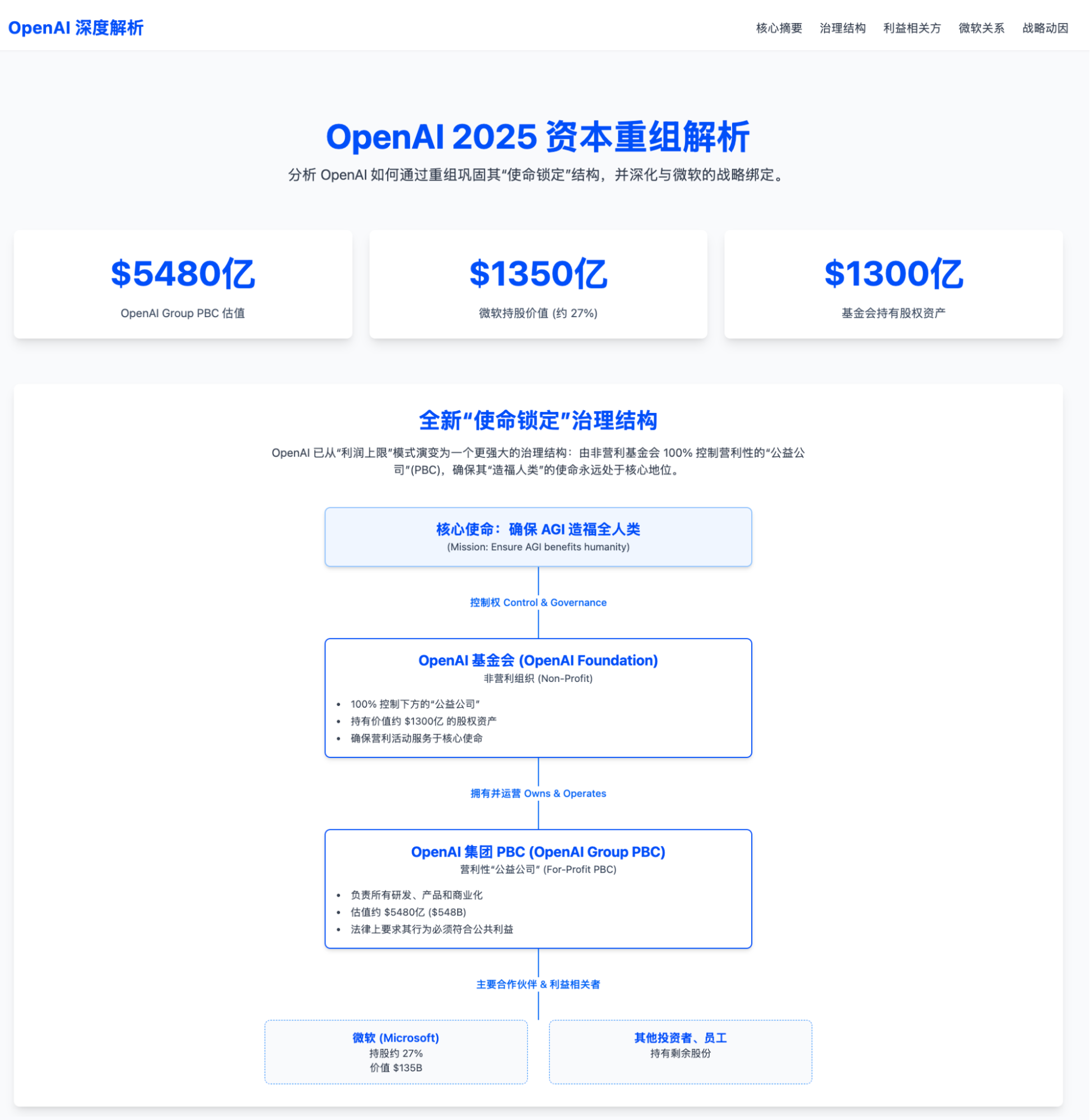
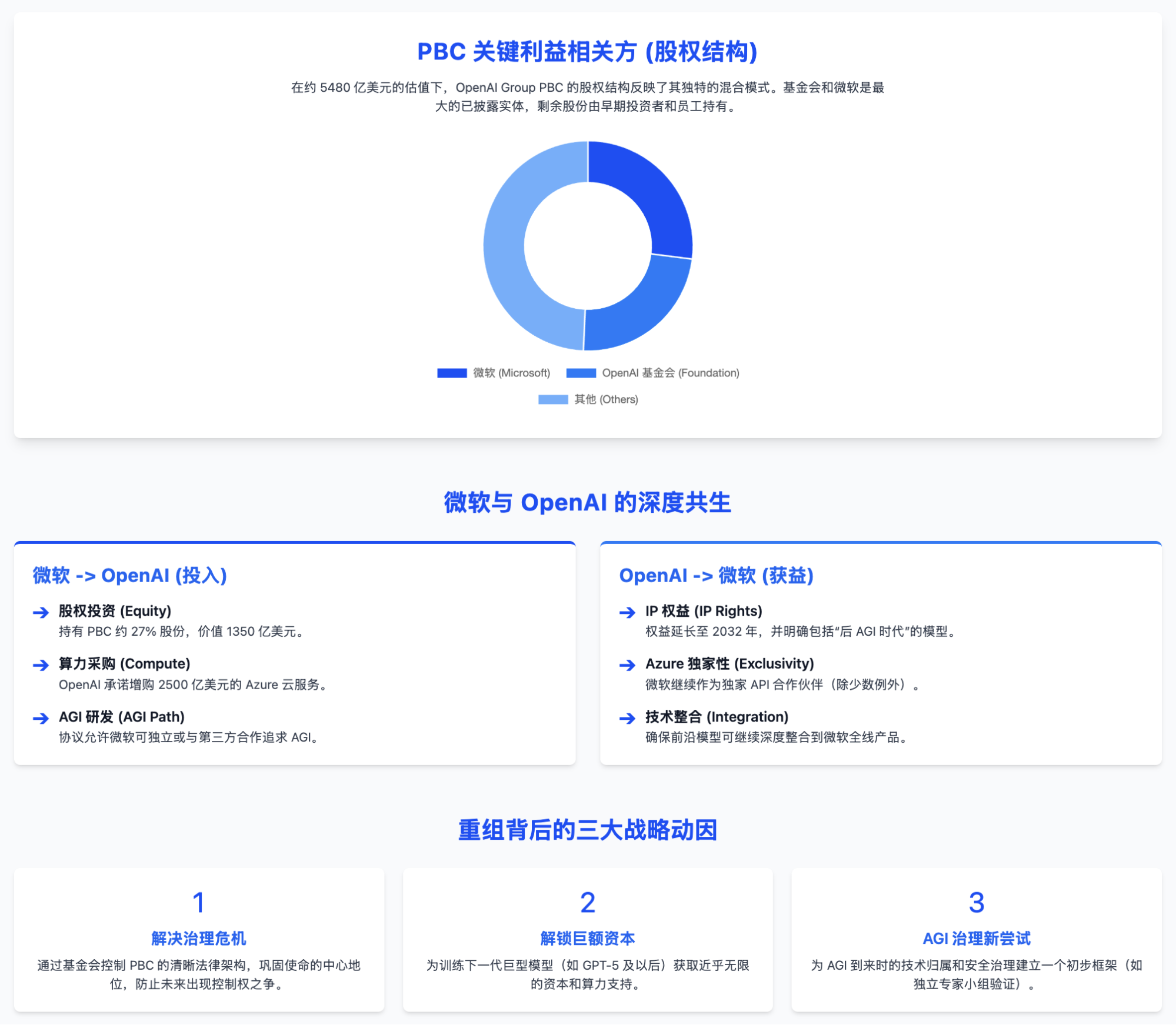
Simply put, Microsoft is making a graceful exit and has secured significant benefits on paper: a 32.5% equity stake (not accounting for the for-profit entity's recent financing), IP rights prior to AGI, and $250 billion in cloud contracts.
OpenAI has completely resolved the structural constraints of being "all-in."
A win-win, right?
But what's the reality?
I won't post the original text of the announcement; instead, here is Gemini's analysis and visualization.
My simple conclusion:
Obviously, if OpenAI achieves AGI, everyone wins—everyone involved in this game wins.
What we need to discuss is if they fail to achieve it: Simply put, Microsoft has exited gracefully (or at least it appears so for now), securing maximum returns and future contracts. Meanwhile, the returns for other entities, including OpenAI’s new investors and partners, must almost entirely come from "achieving AGI." If this bubble bursts at some point, everyone loses.
From now on, OpenAI can finally use equity for financing. Of course, this has become the final means of financing; if there's anything else left, it’s just the "AGI dream."
To further explain the second point:
Microsoft has not only maximized the returns on its equity investment started in 2019 but has also minimized its risk while continuing to participate in the game with a significant share. From now on, OpenAI is essentially both a major computing power customer and a "workhorse" generating IP for Microsoft.
This also means that unless AGI is reached, other participants in the game will see very limited benefits (with the exception of NVIDIA).
But looking back, is Microsoft truly winning? From a market perspective, it feels more like a complete realization of positive news, leaving future imagination in question.
Around this time last year, I wrote about one of the biggest "watchpoints" in the AI field for this year: the conflict of interest between OpenAI and Microsoft. Now that the dust has settled, there's a sense of melancholy, leaving only one question:
Why is it that Microsoft cannot support OpenAI's dream, while Google can smoothly integrate DeepMind and continue to move forward steadily and rapidly as a single entity?