If you use an AI model, can you achieve "software functionality" without writing code? The answer is basically no. Even with "Vibe Coding" or "Cowork," tasks are completed or functions are implemented in the form of "code."
In essence, this is still software; it's just that the developer has shifted from a human programmer to a model.
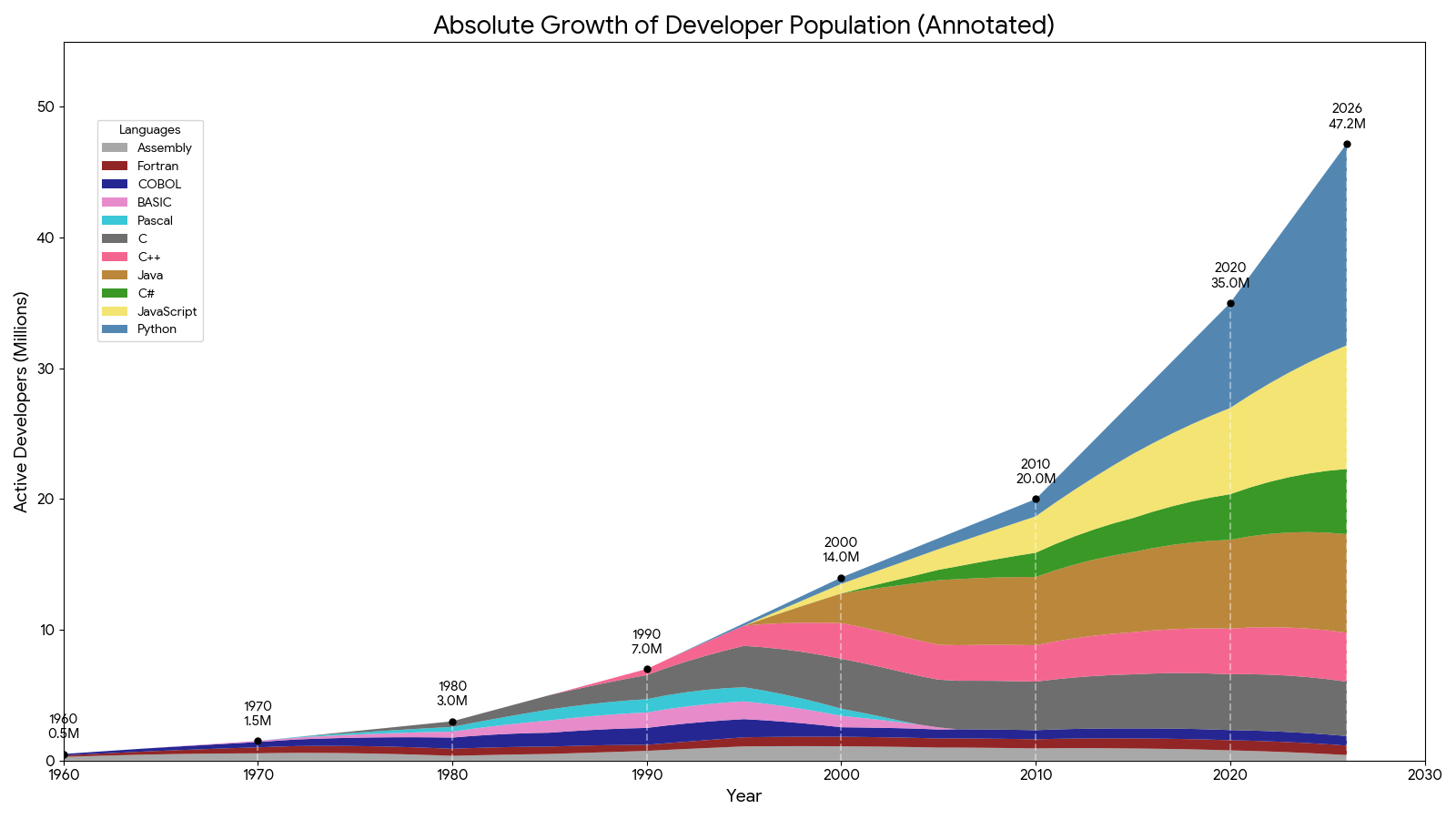
I did some simple searches with Gemini and drew a chart: the change in the number of programmers over time. The software industry has grown at a multiplicative rate alongside the increase in the number and efficiency of programmers.
From Assembly to Fortran, to Basic, Pascal, C/C++, to Java, and then to TypeScript and Python, the barrier to entry has gradually decreased, code reuse rates have risen, and development efficiency has increased rapidly.
However, the total number of programmers has basically doubled every ten years, though the growth rate has declined in the last twenty years due to the larger base.
At every historical juncture—the PC era, the Internet era, the mobile Internet era—the suitable languages and technologies were very clear, but change always takes a longer time to happen.
Perhaps the AI era will allow "everyone to become a programmer," or perhaps programmers will no longer be needed at all.
This is the most important reason why I have always believed that AI "will definitely reconstruct the software industry."
But when actually putting this "philosophy" into practice, one eventually finds that time remains the greatest enemy. Behind time lie the physiological limits of humans and the "human complexities" (social dynamics) within social organizations.
When Fortran was used for scientific computing in fields without so much "human complexity," change happened rapidly. Even today, the population of C/C++ programmers has remained stable for twenty years.
However, the real incremental growth comes from the "popular" languages despised by C/C++ programmers in the "scorn hierarchy"—Java, Python, and TypeScript—those used in a world full of people.
The reason software has become such a massive industry is its reliance on "a world of many people."
Perhaps AI will one day take over, but it won't be today, nor will it be any time in the next three to five years.
I understand what people like "Elon Musk" see, because I once thought the same. But I have also come to realize that when we try to use AI to replace the cornerstone of those industries—people—the so-called demand might not even exist.
This doesn't prevent me from having long since unsubscribed from Photoshop in favor of tools developed with Capture One + models; it doesn't prevent me from needing only simple editors (like Google Docs) + storage (Google Drive) + model-developed tools; and it doesn't prevent a rapid reduction in dependency on third-party software.
However, over the past few years, my biggest problem might have been pursuing the "endgame" too aggressively, gradually losing the joy of "enjoying the process of change."
Change always takes more time.