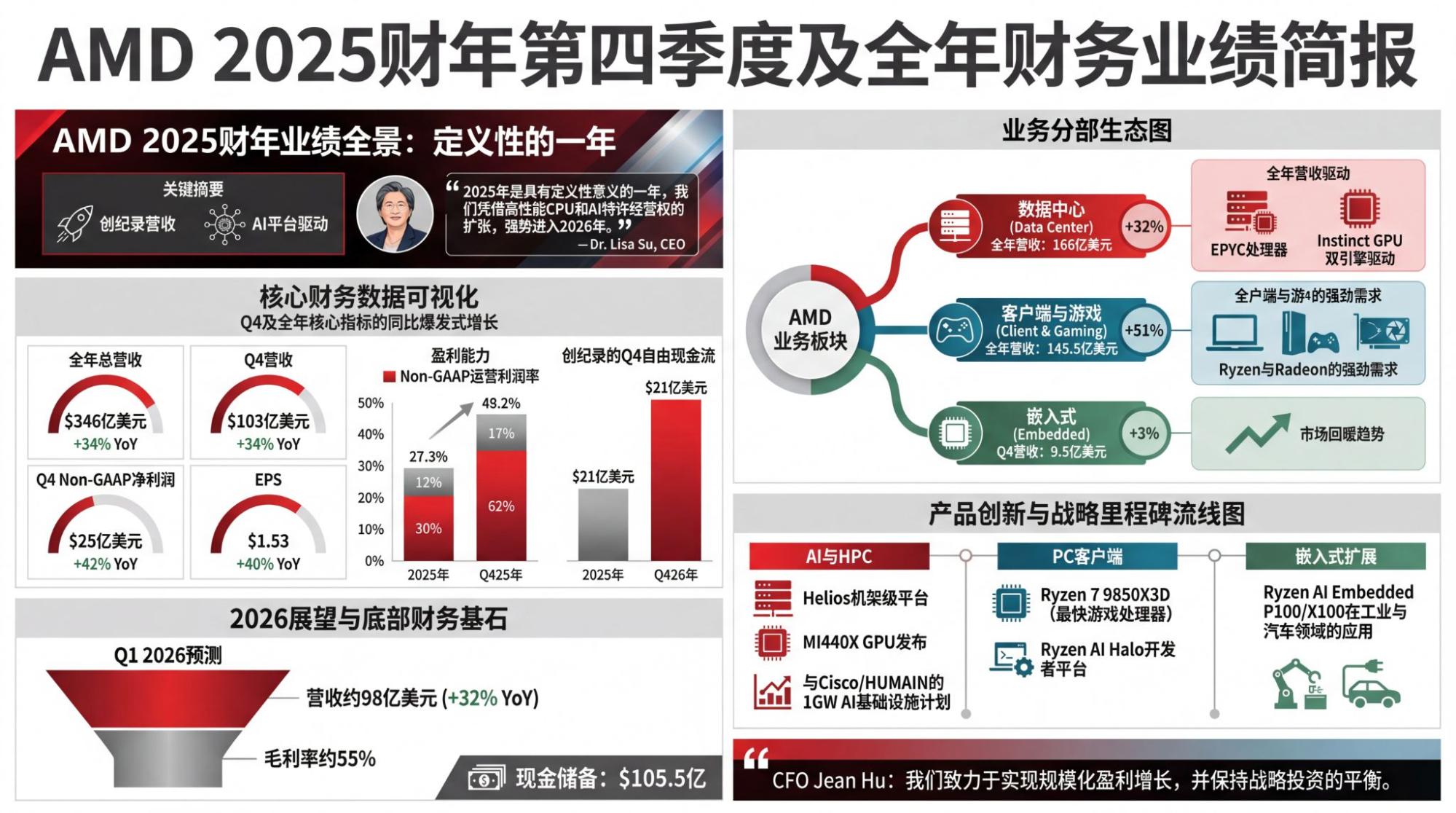
AMD's earnings report was released, and the script of past quarters has played out once again: regardless of whether expectations were exceeded, the market's first reaction is always a drop.
In fact, the direct reason is very simple: in terms of absolute financial performance, it is very good. However, as a challenger to NVIDIA (NV), while the market is growing larger, the gap seems to be widening as well.
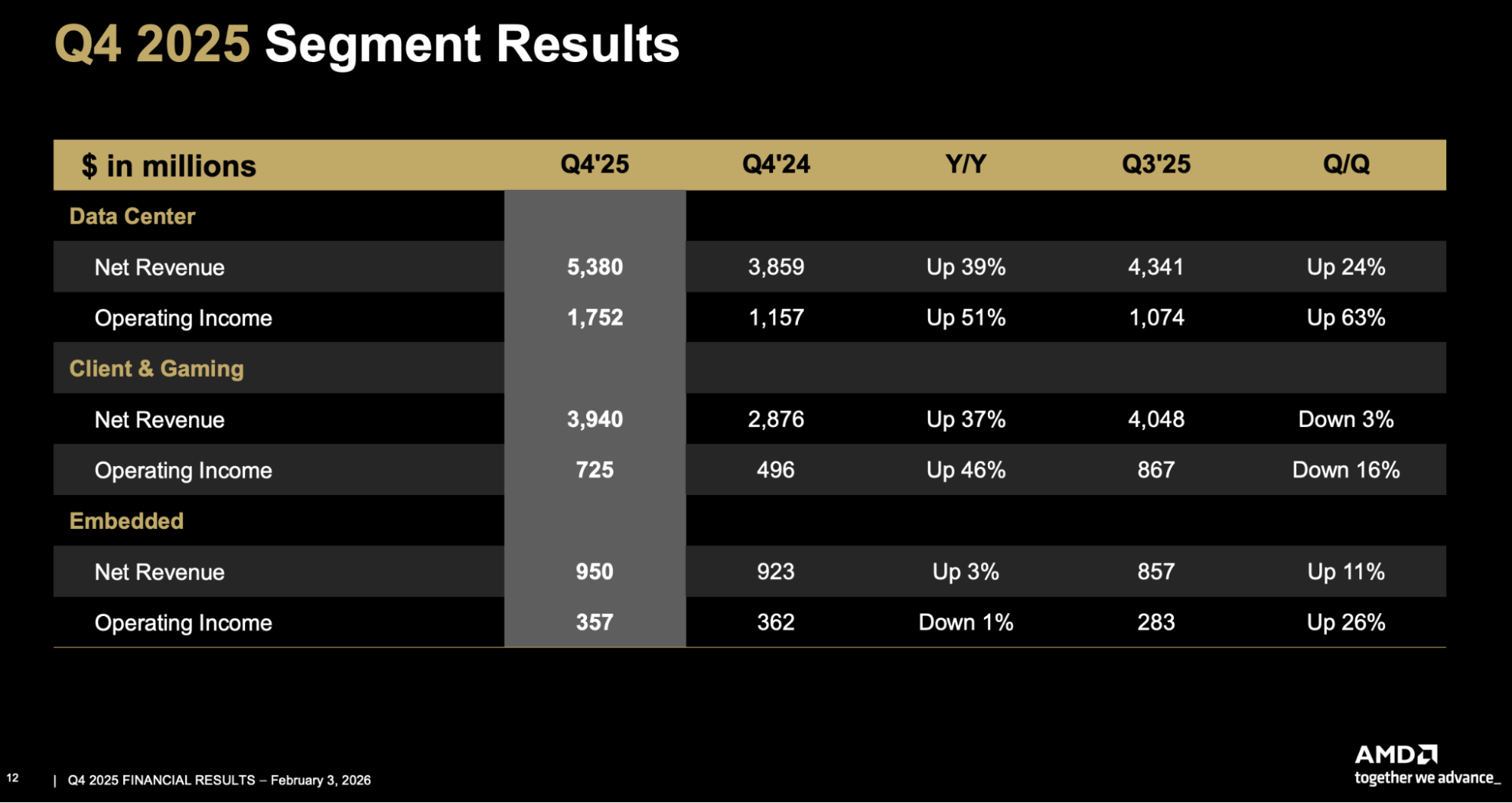
The year-over-year (YoY) growth of less than 40% in the data center segment is underwhelming, and the main contribution likely still comes from CPUs rather than GPUs. Although there are indeed signs of acceleration, in the face of a rapidly growing market pie, it seems their share of even the "scraps" has decreased.
Furthermore, the surge in storage prices has tangibly affected the PC business, with quarter-over-quarter (QoQ) performance already declining. This directly led to a quarterly outlook that, while exceeding market expectations, shows almost no growth sequentially.
From 2024 to 2025, I was bullish on AMD at certain stages because of their CPUs—both for servers and PCs—and because ROCm has indeed improved. However, when trying to think from the perspective of a Cloud Service Provider (CSP) or a model company making technical decisions, it's a completely different story.
When the entire industry chain is willing to bear rapidly rising power costs, data center infrastructure costs, storage costs, and even other material costs at any price, they only care about two things: speed and stability.
This is no longer just a simple lab test; it's a system deployment worth billions of dollars. There is zero room for error. Thus, there are only two logical options: use the most mature solution—because if it fails, you are sharing the risk with your peers—or, if you have sufficient strength, develop in-house.
I have always hated monopolies and uniformity, but the story unfolding in the world today clearly has nothing to do with individuality or value preferences.
The above reflects a judgment that AI lacks, so I used it to generate the cover image—as long as it faithfully reflects AMD's official narrative.