As the largest consumer electronics show, CES is naturally oriented towards the consumer market. Although I have always maintained that the distribution of "computing power" is a "combination of edge and cloud," and that edge devices are more interesting to watch, objectively speaking, the products and future roadmaps released by various manufacturers have once again made me marvel: since the launch of ChatGPT, not only have software and algorithms accelerated significantly, but even hardware development seems to have sped up drastically.
Of course, this isn't because some sudden breakthrough technology appeared, but rather because once the trends in downstream applications became clear, the roadmaps for upstream products naturally followed suit.
NVIDIA, Intel, AMD, and Qualcomm have all released new products or pre-announced future architectures. Related technical specifications and short reviews are already everywhere on social media, so there's no point in me repeating those technical details. Instead, I will provide a brief overview of the changes I've observed.
NVIDIA introduced the RTX Super series graphics cards, but those are aimed at the workstation or desktop market. NVIDIA's share in the discrete graphics card or GPU market has reached an all-time high, and this product line is meant to fill the gap between the professional and enthusiast segments. This market will actually see significant growth, which is why Wall Street responded so positively. However, since this is NVIDIA's exclusive territory, I’m mentioning it first not because it's the most important, but to get it out of the way before discussing more interesting shifts in trends and the competitive landscape.
In the consumer market, a "unified chip architecture" has become a consensus. SoC, enhanced GPU and NPU cores, and unified memory—the architectures and technologies originally used in smartphone chips—are gradually unifying almost all edge devices: PCs, MR, automotive, etc. Apple and Qualcomm are playing this game best, while AMD and NVIDIA also have very rich product lines. As for Intel, it has now adopted an "all-in" posture; after the launch of Meteor Lake, it announced the Arrow Lake and Lunar Lake architectures. The much-discussed "AI PC" boils down to two things: chips and interaction. As I’ve said many times, the best AI PC currently is Apple's Mac. The remaining core question is: how long will it take for Windows to shift from X86 to ARM?
While computing power is important, power consumption and cost are what hardware manufacturers need to focus on most. I don't believe AI PCs based on the X86 architecture are the future, primarily because of power consumption—or rather, power consumption relative to computing power. This is crucial for smartphones, PCs, smart cars, robots, MR devices, and more. Similarly, many of the skeptical voices regarding "AI phones" center on battery life concerns due to power consumption. Thus, when Intel released its new automotive chips, it emphasized power efficiency alongside AI capabilities. AMD, NVIDIA, and Qualcomm are also highlighting low-power products. Beyond power, there is cost. Currently, perhaps only Apple's products are not highly price-sensitive. Therefore, we may see many "budget versions" of products in the near future, which is actually a good thing. After all, in 90% of scenarios, price is king.
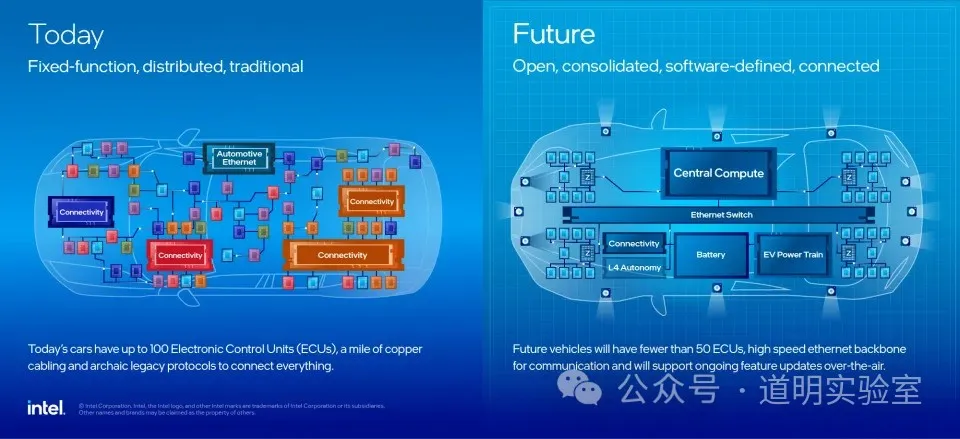
The battleground is unfolding simultaneously in the AI PC and automotive chip markets. On one hand, Qualcomm is rushing into the PC market, AMD is hoping to further erode Intel's share, and Intel is fighting back vigorously. However, the most important player isn't these three companies, but rather what kind of Windows Microsoft produces that is compatible with AI and next-gen chip architectures. On the other hand, Intel (not Mobileye) is making a high-profile entry into the automotive market, targeting unified smart cockpits rather than just autonomous driving chips—the direct advantage being a significant reduction in ECU usage. Actually, NVIDIA's upcoming Thor chip has even greater ambitions: unifying smart driving and smart cockpits. AMD and Qualcomm also have mature products and solutions. Consequently, the AI PC and automotive markets in 2024 will surely be incredibly exciting.
Apple's Vision Pro is about to officially launch. XR is indeed the product category most closely tied to China's supply chain. The specs of Qualcomm's latest VR Gen2 Plus are impressive, and Qualcomm, Google, and Samsung are also co-developing XR glasses. However, while Apple's headset could usher in a new era called "spatial computing," other XR devices still face the massive challenge of building an ecosystem.
Summary: Everyone sees the future, especially the tech giants, so they are all adjusting their directions in a highly consistent manner to prepare for the close-quarters combat that has already begun. Yet, no matter how hard these companies try to explain their new products and imagine their futures, they cannot capture even 10% of the attention that ChatGPT does; it feels more like the tech industry entertaining itself. This is normal—before ChatGPT was released, how many people outside the industry even knew about GPUs like the A100 or H100?
On the surface, it looks like a continuous stream of minor excitement where "each player takes their turn on stage," but much of it may fail to sustain interest for more than a week. Beneath the surface, however, competition has reached a fever pitch. 2024 is indeed the year of large-scale application deployment. Likewise, it may very well be the year the market hands down a suspended death sentence to a former chip giant. No matter how flowery the technology and parameters are described, we still have to wait for sales figures to speak.