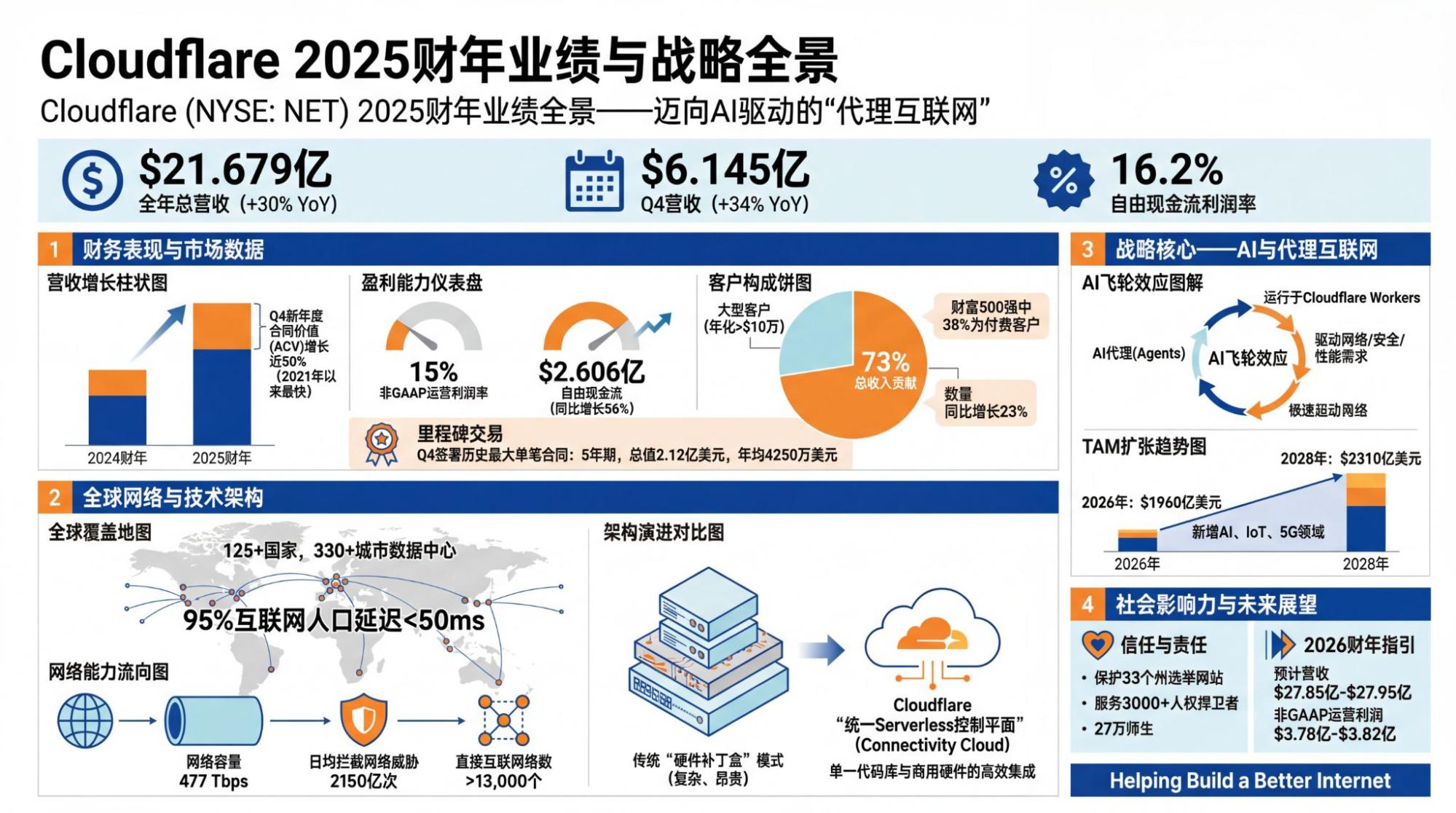
Regarding Cloudflare, I have written numerous technical discussions since migrating all our infrastructure there last year.
Following its better-than-expected earnings report, Cloudflare has received very positive market feedback, even as the software and SaaS sectors remain entangled in the "AI victim" narrative.
Those who are not Cloudflare users might struggle to articulate its core competitiveness or even understand what the company does, other than seeing it in headlines when its outages cause major services like ChatGPT and Claude to go down.
Indeed, most average users encounter Cloudflare through security verifications when visiting websites—those moments where you must click to prove you are human. You will likely see the Cloudflare logo then; they provide this service, especially for many startup apps and websites.
CDN and attack mitigation were Cloudflare's earliest businesses, and today, more than 20% of all internet traffic passes through its network.
However, today's Cloudflare is far from what it used to be:
If we use "vibe coding" to generate a website or app and want to deploy it, there are several options; Cloudflare is one of them.
If we need to assign a domain and perform DNS resolution, there are many choices; Cloudflare is one of them.
If we want to enable security protection for a website, Cloudflare is one of the few viable choices.
If we want to use online databases and object storage, we could choose Supabase, MongoDB, or AWS S3; Cloudflare’s D1 and R2 are inconspicuous but solid options.
If we want to build online image and video storage or galleries, Cloudflare is again an understated option.
If we want AI to help manage our website with regular backend updates and front-to-back synchronization, Cloudflare’s Workers/Pages—which seemed abstract at first—have become incredibly useful over the past year, with Vercel being their primary competitor.
If we want our AI applications to have access to multiple model APIs, including open-source ones, Cloudflare offers AI Gateway, among many other competitors.
Cloudflare also offers containers (virtual machines), Queues, Workflows, Vectorize, and much more.
No single service is unique to Cloudflare, yet no other company provides such a complete, all-in-one suite of products.
When I consider the framework for the future of AI, I divide it into three categories: Model Ecosystem Monopolists, AI Ecosystem Supporters, and "Pick-and-Shovel" Sellers.
I believe Data and Security services are the only two long-term beneficiaries among the "AI Ecosystem Supporters." Cloudflare's entry point is clear: when we deploy AI applications on the internet, hosting and security are the primary concerns, followed by the convenience and security of data storage, and thirdly, the ease of serverless calls.
If an all-in-one solution is possible, it becomes the only choice.
Cloudflare is that unique choice—the supporter of the next generation of the internet.
That covers the technical aspect.
Financially, its valuation is high, and it has only just begun to be profitable. It is difficult to foresee a quarter with massive explosive growth—say doubling or growing over 60-70%. While its gross margin is high, its expenses are also high (such as sales and administrative costs), and it faces potential pressure from convertible bonds.
However, it comes down to a simple technical choice: when I decided to move all my infrastructure to Cloudflare, I realized two things. First, major cloud providers cannot offer such a clear and easy-to-deploy product structure (they are bound by the bureaucratic and bloated management processes of large enterprise clients). Second, I dare not use any niche vertical solutions because they lack an all-in-one capability and I can't guarantee their survival. While I can't guarantee Cloudflare won't fail either, if it goes down, it will likely take a massive chunk of the internet's major players with it.
I trust my technical aesthetic. I believe in this model—one that seemingly has competitors everywhere but actually has none, serving a market with immense imaginative potential: NGI, the Next Generation Internet.